Eight Bay-Area Contributors to 99 Poems for the 99 Percent: An Anthology of Poetry will read their own work and work from the anthology on Saturday April 4 at 7:00 at the legendary Book Passage in Corte Madera, CA.
The list of authors reading includes:
Roy Mash
Charles Kruger
Katie Capello
Gordon Smith
Rachelle Escamilla
David Fox
Jose Luis Gutierrez
Hiya Swanhuyser
Celebrate National Poetry Month and American Democracy at the same time!
Thursday, April 2, 2015

Monday, February 2, 2015
No one is making Target take 99 Poems for the 99 Percent off the shelves!
We don't promise anything we cannot deliver--99 original, organic, herbal supplements.
http://www.target.com/p/99-poems-for-the-99-percent-paperback/-/A-16469325
http://www.target.com/p/99-poems-for-the-99-percent-paperback/-/A-16469325
Friday, September 26, 2014
99 Poems on the Bus T-shirts
.JPG)
Tuesday, September 23, 2014
99 Poems Comes to Kepler's
The legendary Kepler's in Menlo Park hosted six contributors to the 99 Poems anthology on September 18. Readers included Ellen Bass, Sally Ashton, J. P. Dancing Bear, Rachelle Escamilla, and Dennis Richardson. Every available seat was taken! Readers signed books, met with old friends, and answered questions about poetry and politics.
 |
| Ellen Bass talks about her father's long employment history in "My Father's Day" |
 |
| Dennis Richardson talks about both Frogs and the French |
 |
| Rachelle Escamilla dazzled everyone with her poem and her stories about growing up with immigrant parents |
 |
| Sally Ashton reads Brian Clement's poem "A February Revolution" |
 |
| J. P. Dancing Bear reads "By a Monkey on a Unicycle" |
99 Poems for the 99 Percent Invades Santa Cruz
On September 8, several contributors to 99 Poems for the 99 Percent marched on Santa Cruz, taking over Bookshop Santa Cruz. Below are photos released last week by Gawker:
 |
| Sally Ashton reads her poem in Three Voices |
 |
| Joan Gelfand tells the 1% to talk to the hand. |
 |
| CJ Sage reads from her poem "To Occupy: An Advice" |
Wednesday, September 10, 2014
Podcast of 99 Poems Anthology read on KUSP Poetry Show
Hear Santa Cruz legend Dennis Morton read poems from 99 Poems for the 99 Percent on the nation's oldest poetry-only radio show. http://blogs.kusp.org/poetryshow/
Tuesday, September 9, 2014

Images from the San Francisco Reading and Release Party for 99 Poems for the 99 Percent - Sept 3, 2014
 |
| Julie Bruck wows the crowd of the Booksmith |
 |
| Keith Ekiss reads a poem about the Mission District |
 |
| Barbara Berman imagines Walt Whitman on Wall Street |
 | |
| Barbara, Julie, and Hiya can't take their eyes off of Gillian Conoley |
Wednesday, August 6, 2014
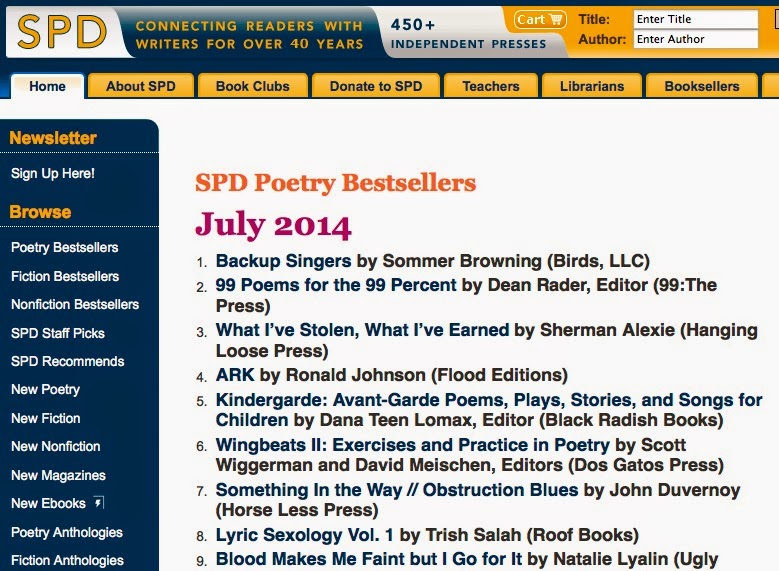
99 Poems for the 99 Percent hits #2 on the SPD Bestseller List
99 Poems for the 99 Percent: An Anthology of Poetry is at #2 on the Small Press Distribution Poetry Bestseller List and comes in at the very top of the "SPD Recommends" page.
Dana Levin, Rich Bouchet, and Jon Davis read from 99 Poems for the 99 Percent!
99 Poems for the 99 Percent, held the first of many reading/release parties at the Santa Fe University of Art & Design on July 26, 2014. Jon Davis, Rich Bouchet, Dana Levin, and Dean Rader read their own poems from the anthology as well as work by Bob Hicok, Catherine Esposito Prescott, Camille T. Dungy, Alexandra Teague, and several others:
 |
| Jon Davis adopts a creepy persona in his fabulous poem "Preliminary Report from the Committee on Appropriate Postures for the Suffering" |
 |
| Rich Bouchet adopts an even creepier persona for his poem "Gently Now, Gently, Gently Into Your Black Tactical Duty Jacket, Your Striped Plunge Bra with Cherry Charm" |
 |
| Dana Levin adopts her always cool persona for her haunting poem "Morning News." |
Memory/Memorial, Ingrid Wendt
MEMORY/MEMORIAL
Ingrid Wendt
You whose family four years
fled through jungles, whose mother,
Camp by camp, weakened, the
cancer left to spread, untreated
You, whose mother fled with
her children from Russian invasion
Your train bombed and bombed
again as it inched its way south
You whose daughter
disappeared on her everyday route home.
You to whom a government gave
blankets riddled with smallpox
You whom radiation ravaged,
whose fatherland won’t remember
You for whom the midnight
knock on the door will echo forever
You for whom the syllables
Tiananmen, Kent State, still smolder
You whose generation’s memory
is short
You who cannot bear the sound
of movie gunfire, cars’ backfires
You who’ve gathered together
severed limbs from the wreckage
The swamp water; you, family
whose mourning can never begin
You who never again will look
into cameras, you who have seen
More of the face of evil than
anything minds can begin to imagine
You who look for reasons
where none exist, who bring to these
Elegies, images of your own,
too deep for speech, wave upon
Wave they return when least
you expect them, flotsam weighing
The future down. What shape
do we give to horror, what form?
Silence between the paving
stones of these stanzas: this is for you.
About "Memory/Memorial," Ingrid Wendt writes:
"
Throughout
human history, with all of its changes, one thing is constant in every country
in the world: for every horror, every death, caused by other human beings –
from large-scale warfare to airline crashes to the kidnapping and murder of a
child coming home from school – there are those left behind who remember, who
mourn, who often are isolated in their grief and in their inability to give
shape to it.
This
poem belongs to a 10-part poem sequence: my part of a collaborative project
with a sculptor and painter in 1999. The horrors I refer to are events in the
Philippines and Germany during and after the second world war, in China, Chile,
Argentina, the United States during the Indian wars, and the United States
today. For this poem, I created all lines (except one) of nearly equal length,
to resemble paving stones of an imagined path.”
Friday, July 18, 2014
99 POEMS FOR THE 99 PERCENT: AN ANTHOLOGY OF POETRY - NOW AVAILABLE FOR PURCHASE
99 Poems for the 99 Percent, the popular blog begun by Dean Rader, is now available in book form, complete with notes about the poems written by the poets themselves. With contributions by Edward Hirsch, Dana Levin, Timothy Donnelly, Bob Hicok, Rachel Loden, Maxine Chernoff, Camille T. Dungy, Patty Seyburn, Rey Gonzalez, Matthew Zapruder, Hadara Bar-Nadav, Alexandra Teague, Jon Davis, Tess Taylor, Keith Ekiss, Joan Houlihan, Fred Marchant, Martha Collins, Robert Pinsky, LeAnne Howe, and a host of other writers, this collection represents one of the most pertinent and topical collaboration of poetry and politics.

Order your copy today from Small Press Distribution or Amazon
Thursday, December 1, 2011
February Was Only Half Over, Ellen McGrath Smith
FEBRUARY WAS ONLY HALF OVER
and so we decided to roll the coins. We emptied all tin cans
and urns on the bed, and the bedspread was covered in coins.
The first large-scale contracts related to Hurricane Katrina, as in
Iraq, were awarded without competitive bidding, and using so-called
cost-plus provisions that guarantee contractors a certain profit
regardless of how much they spend.
Iraq, were awarded without competitive bidding, and using so-called
cost-plus provisions that guarantee contractors a certain profit
regardless of how much they spend.
We decided to pawn the wedding ring. On the bus
on the way back, I cried to remember the love-knots
were deliberate and started in wax. Then the gold
was poured over. I paid the light bill with that.
Expecting nothing but the best, Margaret Ann wants to throw the biggest Sweet 16 party in South Carolina history. In anticipation of her birthday, Margaret Ann first goes shopping with her mom at the BMW dealer. After Margaret Ann's mom buys her a flashy convertible, she goes on a shopping spree with her dad who treats her to almost 2000 dollars worth of new clothes.
Those rolling tubes ran out, and so we decided to count out
the coins, then divide them in stacks and wrap units in foil:
50 pennies; 40 nickels=$2; 50 dimes=$5; 40 quarters=$10.
Based on data collected from five participants (and counting) and multiple anecdotes, rolling coins should not take more than two (2) minutes a roll for most people, although some individuals may take longer. At two minutes a roll, you would save only $1.34 an hour for rolling your own pennies (60 minutes / 2 minutes roll = 30 rolls * 50 coins a roll * 8.9% or 4.45 cents fee each roll = $1.32.) However, for each higher denomination, the amount saved rises as shown in the table.
We decided to sell the antique dental cabinet. Over the Internet,
I pretended I knew what I had. That took care of half my June expenses.
This was the year the cost of cigarettes spiked. I bought my own
rolling machine. I spent much of that year rolling coins and tobacco.
Brad Johnson noted in today’s Progress Report that “the Bush tax cuts for the wealthy are greater than the entire salary of most Americans.”
We decided that, after rolling coins, our hands had touched everyone,
somehow. Some people soak them in bleach first — for germs —
but getting sick was the last thing on my mind. Penetrating every sleeve
with my upright middle finger, I was getting through the month.
I was getting through the month and touching everyone.
_____________________
About "February Was Only Half Over," Ellen McGrath Smith writes:
"February Was Only Half Over" was first published in Kestrel (Spring 2010): http://www.fairmontstate.edu/
Wednesday, November 30, 2011
Variation on a Theme by Milosz Misquoted by Robert Hass, Bradley Harrison Smith
VARIATION ON A THEME BY MILOSZ MISQUOTED BY ROBERT HASS
Lunch Poems Reading Series, Berkeley 2004
O to see through teargas! The color flash grenade—
wait—
O to see through teargas the flash grenade transfigure what was once
in colored Oakland the flooded street ablaze!
The numbing quiet spilled from flesh the stun grenade
ripped open. O molten scent of what it stung—
________________________
About "Variation on a Theme by Milosz Misquoted by Robert Hass," Bradley Harrison Smith writes:
This poem is written after a Robert Hass reading in 2004 in which he attempted to recite a translation of Czeslaw Milosz by memory but messed up and had to restart. It is dedicated to Scott Olsen, the former Marine and Iraq War vet who sustained a skull fracture in the Occupy Oakland protests due to police brutality.
Friday, November 18, 2011
Noble Savage Learns to Tweet, LeAnne Howe
NOBLE SAVAGE LEARNS TO TWEET
Timeline Mentions Retweets Searches Lists
Noblesavage Noble Savage I walk alone
11 seconds ago
10 seconds ago
9 seconds ago
8 seconds ago
7 seconds ago
6 seconds ago
5 seconds ago
20 hours ago
1 hour ago
3 hours ago
1 hour, thirty minutes ago
10 minutes ago
2 minutes ago
Noblesavage Noble Savage Hear on Wall Street, cool females wanted with that “suicide girl look!” Read more at @#AI.com
1 second ago
______________________
About "Noble Savage Learns To Tweet," LeAnne Howe writes:
1) 1. Dutch settlers built the ‘Wall path’ sometime around 1692 to keep out the Indians. In other words it was built for whites settles to keep out undesirables to protect developing commerce. According to Hermes-Press.com, the Wall path “joined the banks of the east river with those of the Hudson River on the west.” Wall path later named Wall Street. Hence the poem’s narrator, Noblesavage, tweets irony.
2) 2. “Indian agent” is a double entendre and can be read as Noblesavage’s agent, authorized to act on his behalf for acting roles in Hollywood westerns; or as an individual authorized to interact with American Indians authorized on behalf of the federal government.
3) 3. “Ford and Cameron” refer to Hollywood film directors John Ford and James Cameron.
4) 4. #AI.com is a site for “artificial intelligence.” Another irony, Noblesavage is not real, a creation of Hollywood imagemakers.
Wednesday, November 16, 2011
The Last Gesture, Hadara Bar-Nadav
THE LAST GESTURE
Hadara Bar-Nadav
Hadara Bar-Nadav
My hand grew big as a house.
It was heavy to carry
and drag through the streets.
I staggered across the lawn
on gravel-burned knees
to watch the home
I could no longer enter.
My wrung wrist turned blue.
My shoulder bled.
Skin tore up my neck
and split open my eye.
I had given too much.
I had taken too much.
The hand grew
as the sky grew,
hand the size of wind
expanding until it was no longer
my own, until the weight
buried me.
_______________________
About "The Last Gesture," Hadara Bar-Nadav writes:
The “The Last Gesture” is from my first book, A Glass of Milk to Kiss Goodnight (Margie/Intuit House, 2007). I’m still humbled by the lines: “I had given too much / I had taken too much.” Those lines remind to walk carefully though this world, often full of many difficult and strained exchanges regarding money, objects, love, and life.
About "The Last Gesture," Hadara Bar-Nadav writes:
The “The Last Gesture” is from my first book, A Glass of Milk to Kiss Goodnight (Margie/Intuit House, 2007). I’m still humbled by the lines: “I had given too much / I had taken too much.” Those lines remind to walk carefully though this world, often full of many difficult and strained exchanges regarding money, objects, love, and life.
Saturday, November 12, 2011
CONSIDERING HAPPINESS, BY CATHERINE STAPLES
Considering Happiness
There’s no scoop in the grain bin
with which to measure a modest contentment,
no Arden, no unmapped hundred-acre wood.
Here there are city parks and places under bridges,
shanties where you dare not sleep. But no
leveling green wood for the dispossessed.
Still if fortune keeps your feet from the fire,
unsteadily, but with luck, you might
like the divorced Hicks street mother of three
raise chickens in a backyard hutch, petition
the old Italian men for tips on growing
winter chard, kale, & beets in a cold frame.
Twenty-somethings debate coffee grounds in compost
and heirloom seeds while the construction worker
in the metal-tipped boots has gone quiet,
hands deep in his pockets; we cannot know
why he’s here, but we’re hearing everything
from the girl who wants her loans forgiven
because the government bailed out the banks.
And she won’t vote for Obama again,
she may not vote at all. She favors anarchy.
Shall I distract her with the mystery of the red bees
of Red Hook or tell her about the friend of a friend
who farms all year down by the naval yard—
an old asphalt play lot gone heady with cornstalks,
sunflowers, every blessed vegetable under the sun
and the neighborhood boys busy every afternoon.
Shall I choose amity over rancor or retreat
while advancing and speak riddles like Feste,
“The better for my foes and the worse
for my friends” or just be plain and say
that for me contentment is three children
under the same roof, the kettle whistling, a book
tipped on its side, splayed open to the left off page
and waiting for the next conversation to begin.
_____________________________
About "Finding Happiness," Catherine Staples writes
The Wallace Stevens question of finding “what will suffice” led me to thinking about a line from As You Like It: “some settled low content” and about the pastoral notion that one might make do with exile in the wood of Arden. But when you live in the city, how can you access the pastoral, the healing green? In terms of setting, I drew upon my brother Paul’s New York—from under the arc of the Brooklyn Bridge to the varied neighborhoods where long wandering bike rides took us.
Subscribe to:
Posts (Atom)